
Cloud Data Warehouse Modernization
Cloud Data Warehouse Modernization for Banks & Financial Institutions
Modern Data Warehouse Services for Financial Analytics
Modern Data Warehouse Services extend beyond simply storing structured information. They can include warehouse design, data migration, data modeling, integration, pipeline development, performance optimization, governance, and analytics enablement. Many financial institutions continue to rely on legacy data warehouses that were not designed to support today's analytics, AI, and real-time data demands. These systems are often expensive to maintain, slow to scale, and difficult to integrate with modern data sources. At Datageny, our Cloud Data Warehouse Modernization services help financial organizations transform outdated data platforms into scalable, cloud-native analytics environments built for the demands of 2026 and beyond. We modernize existing architectures to support faster insights, improved query performance, and future-ready analytics capabilities — all while maintaining the governance and compliance standards that financial services requires.
Modern Data Warehouse Platform Assessment
A Modern Data Warehouse assessment should begin with the organization's business requirements, existing technology environment, data sources, workloads, governance requirements, and long-term analytics objectives. Data Geny evaluates the existing warehouse environment and identifies opportunities for modernization, migration, integration, performance improvement, and analytics enablement. The objective is not simply to replace an older platform. It is to create an architecture that can support evolving financial data requirements.
Our migration approach is platform-agnostic. We support migrations to Snowflake, Google BigQuery, Amazon Redshift, Azure Synapse Analytics, and Databricks — selecting the platform that best fits your data volume, query patterns, latency requirements, and existing technology stack. We handle schema conversion, historical data migration, incremental load design, and cutover planning, ensuring that analytics operations continue without interruption throughout the migration window.

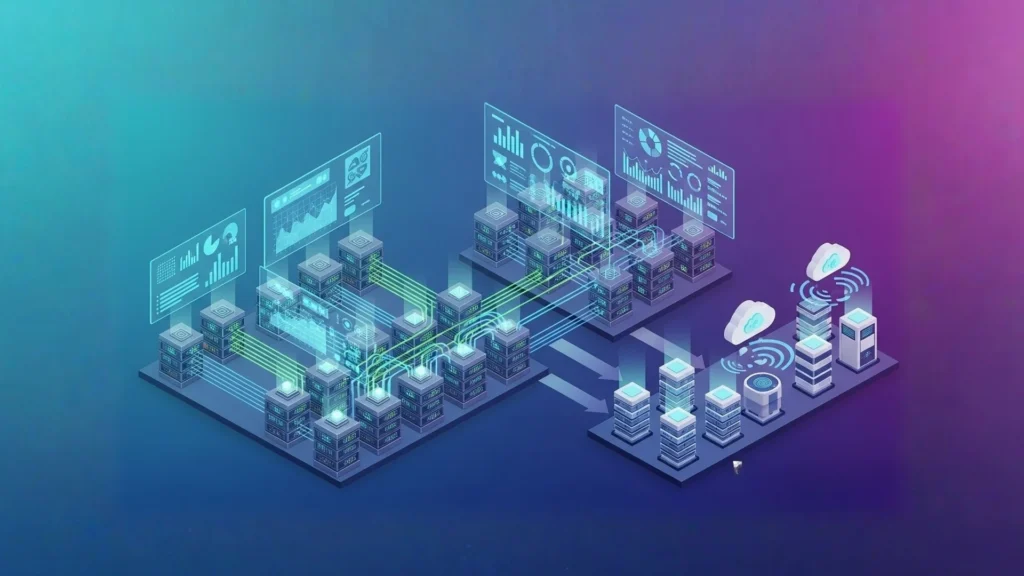
From Legacy Warehouses to a Modern Data Warehouse
Legacy warehouses can become difficult to scale as data volumes and analytical requirements increase. Modernization provides an opportunity to redesign the data environment around cloud scalability, automated pipelines, flexible computing, modern integration, stronger governance, and advanced analytics.
Migration planning should consider existing data models, dependencies, workloads, data quality, downstream applications, reporting requirements, and business-critical processes.
Data Geny’s Cloud Data Warehouse Modernization approach focuses on creating an analytics-ready environment rather than simply moving an existing warehouse to cloud infrastructure.
Once your data warehouse is modernized, connecting it to AI and machine learning pipelines becomes structurally straightforward. Our Machine Learning & AI Solutions services are designed to consume data from cloud-native warehouse environments — enabling predictive models, fraud detection systems, and credit scoring engines to operate on the freshest available data with minimal pipeline latency. Our teams handle Snowflake and Databricks migration projects with a modern cloud data warehouse as the end state
Cloud Data Platform Architecture Built for Financial Workloads
A modern Cloud Data Platform Architecture can combine cloud data warehouses, data lakes, real-time processing, automated pipelines, machine learning platforms, governance frameworks, and business intelligence tools. This allows different financial teams to work from a connected data foundation while supporting specialized workloads. Risk teams can analyze historical credit information. Fraud teams can process transaction data. Executives can access governed dashboards. Data scientists can use the same environment to develop predictive models. Data Geny approaches cloud architecture as a connected ecosystem rather than treating data engineering, analytics, governance, and AI as separate technology projects.
We also implement FinOps governance practices from day one — tagging resources, establishing budget alerts, monitoring query costs by team and workload, and identifying optimization opportunities before cloud spend becomes a management problem. The result is a more agile analytics environment that adapts quickly to changing business requirements without delivering billing surprises at the end of each month.

Secure and Governed Cloud Data Warehouse Modernization
Security and compliance are non-negotiable in financial services. Cloud adoption must be paired with strong governance and risk controls that meet the requirements of regulators including the FCA, SEC, DORA, GDPR, and applicable national banking authorities. We embed data governance, role-based access controls, column-level encryption, dynamic data masking, and full auditability into every cloud data platform we design. Our solutions support regulatory requirements while maintaining transparency and trust in cloud-based analytics operations.
Data lineage is built into the architecture from the start — not added as an afterthought. Every transformation, load, and query is traceable, supporting the audit requirements of BCBS 239 and similar frameworks. Our Enterprise Data Governance & Privacy Strategy services extend this foundation further, ensuring that governance policies, data ownership, and access controls are consistently enforced across the modernized warehouse environment and the broader enterprise data ecosystem includes ELT modernization and ongoing data warehouse performance optimization once you’re live.
Data Warehouse Services Validation Checkpoints
Successful Data Warehouse Services require validation throughout the modernization lifecycle. Validation should confirm that data has migrated accurately, transformations produce expected results, downstream reporting remains reliable, and critical analytical workloads continue to operate correctly. Data quality checks, reconciliation, lineage, monitoring, and testing can be incorporated into migration and modernization workflows rather than being treated as a final step. This creates greater visibility into data integrity before and after workloads are moved to the modern environment.
Financial institutions that delay modernization face a different kind of cost: the growing gap between their analytics capabilities and those of competitors who have already moved to cloud-native platforms. In a market where data-driven decisions in credit, fraud, treasury, and customer analytics are a primary source of competitive differentiation, infrastructure limitations translate directly into competitive disadvantage.

Cloud Data Warehouse Modernization for AI and Advanced Analytics
Cloud data warehouse modernization is a critical step in enabling advanced analytics, AI, and digital transformation in financial services. Organizations that modernize their data platforms gain speed, scalability, and the operational resilience that modern regulatory requirements increasingly demand. At Datageny, our Cloud Data Warehouse Modernization services help financial institutions unlock the full potential of cloud analytics platforms — from the initial migration through to ongoing optimization and governance. Contact us today to begin your journey toward a modern, cloud-first data ecosystem built for performance, compliance, and long-term growth.