
Data Pipeline Automation & Orchestration
for Financial Institutions
As financial institutions accumulate more data pipelines feeding more reports, models, and applications, manually managing when each pipeline runs, how it handles failures, and how dependencies between pipelines are sequenced becomes increasingly unsustainable. Data Pipeline Automation and orchestration replaces this manual coordination with systems that reliably schedule, sequence, monitor, and recover data pipelines at scale. At Datageny, our Data Pipeline Automation & Orchestration services help financial institutions build orchestration frameworks that keep complex data pipeline ecosystems running reliably, with far less manual intervention than ad hoc scheduling and monitoring requires.
Workflow Orchestration Framework Becomes Critical at Scale
A handful of simple data pipelines can be managed manually without much difficulty — but institutions with dozens or hundreds of interdependent pipelines quickly find that manual coordination becomes a genuine operational risk. A single upstream failure can cascade through dependent pipelines undetected for hours, and simply knowing which pipelines depend on which others becomes difficult to track without proper tooling. We help institutions recognize when they have crossed this complexity threshold and build a Workflow Orchestration Framework appropriate to the scale and interdependency of their pipeline ecosystem.
This orchestration layer is what transforms a collection of individually functioning pipelines into a genuinely reliable, manageable data operation.

Building a Workflow Orchestration Framework With Modern Tooling
We build orchestration solutions using modern workflow orchestration tools such as Apache Airflow, Dagster, and cloud-native orchestration services, designing dependency graphs that accurately reflect how pipelines relate to each other and configuring retry logic, alerting, and failure handling that catches problems quickly and routes them to the right team. This tooling-based approach replaces fragile custom scheduling scripts with a Workflow Orchestration Framework that is visible, auditable, and maintainable by more than a single engineer who built the original system.
Our Data Engineering & Integration services provide the underlying pipeline development work that orchestration frameworks coordinate, ensuring individual pipelines and the orchestration layer managing them are designed together rather than as separate concerns.
Automated Data Quality Checks Within Orchestrated Pipelines
Orchestration frameworks provide a natural point to embed Automated Data Quality Checks — checking schema conformance, completeness, and anomaly detection as a formal step within the pipeline sequence, with failed quality checks halting downstream processing rather than allowing bad data to propagate silently. We build these quality gates directly into orchestration workflows, ensuring data quality is enforced systematically rather than depending on individual pipeline developers remembering to add validation logic.
Our Data Quality Management & Validation services define the quality standards and validation logic that get embedded into these orchestrated quality gates, connecting quality strategy directly to operational enforcement.

Pipeline Monitoring & Alerting for Pipeline Health
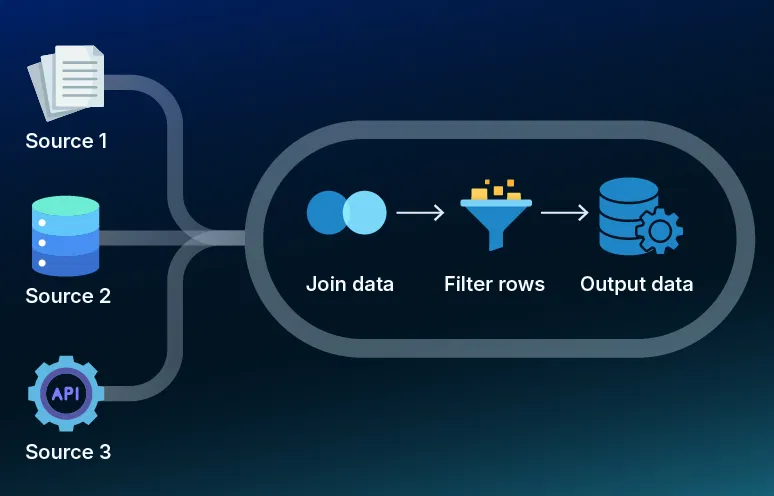
Orchestration frameworks give institutions visibility into pipeline health that manual scheduling cannot match — dashboards showing which pipelines succeeded, which failed, how long each run took, and where bottlenecks are emerging over time. We build Pipeline Monitoring and Alerting configurations that route different types of failures to the appropriate teams, with escalation logic that ensures critical pipeline failures affecting downstream reporting or models get immediate attention rather than being discovered hours later when a stakeholder notices stale data.
Our Operational KPI & Performance Analytics services extend this pipeline health visibility into broader operational dashboards, giving data and technology leadership a consolidated view of data operations health alongside other operational metrics.
Data Pipeline Automation: From Fragmented Workflows to Automated Enterprise Data Operations
Our engagements begin with a structured assessment of your current orchestration environment, including operational workflows, pipeline dependencies, governance frameworks, scheduling systems, observability capabilities, cloud architectures, monitoring environments, and organizational accountability models. We focus not only on automation opportunities, but on whether enterprise workflows can support operational responsiveness, AI scalability, governance visibility, and enterprise coordination effectively. From there, we design a Data Pipeline Automation and orchestration capability aligned with your institution's operational priorities, governance obligations, AI maturity, and enterprise transformation objectives.


Institutions With a Workflow Orchestration Framework Will Scale Intelligence Faster
Financial institutions are entering a period where operational competitiveness increasingly depends on the ability to coordinate, automate, govern, and operationalize enterprise workflows continuously across AI systems, customer environments, analytics ecosystems, operational processes, and compliance architectures. AI-driven operating models are increasing demand for continuously adaptive orchestration environments. Real-time operations require low-latency workflow coordination. Governance expectations around lineage visibility and operational accountability continue to expand.
Organizations still relying primarily on fragmented scheduling systems, manual interventions, and disconnected orchestration workflows will struggle against competitors capable of operationalizing continuously coordinated enterprise intelligence ecosystems through a proper Workflow Orchestration Framework. The gap between institutions modernizing enterprise orchestration capabilities and those maintaining fragmented operational workflows is likely to widen significantly over the next several years.
Automated Data Quality Checks: How Much of Your Data Operation Still Depends on Manual Coordination?
If enterprise workflows still rely heavily on manual monitoring, if operational teams spend significant time resolving pipeline failures and reconciliation issues, or if AI and analytics systems struggle because orchestration environments lack scalability and observability, the issue is not simply workflow complexity. It is a capability gap in how enterprise operations coordinate intelligence across the institution. Our pipeline automation assessment provides a structured view of where orchestration bottlenecks exist, where governance and observability gaps remain, and what changes are required to build a scalable, AI-ready automation and orchestration capability for your institution.Data pipeline automation and orchestration is what allows financial institutions to operate a genuinely complex data ecosystem without a proportionally large operational burden. At Datageny, our Data Pipeline Automation & Orchestration services help institutions build orchestration frameworks that keep data flowing reliably, catch problems quickly, and scale efficiently as the number and complexity of pipelines grows. Contact us today to strengthen how your organization automates and orchestrates its data pipelines.