
Data Quality Management & Validation
Financial Data Quality Framework: Accurate, Validated, Audit-Ready
Data Validation for Banks and Regulated Lenders
Every predictive model is only as good as the data behind it — our Financial Data Quality Framework starts there. Poor data quality is the most pervasive and costly problem in financial services analytics. Credit models that are trained on inaccurate data produce inaccurate predictions. Risk reports that contain incorrect figures mislead the management and boards that rely on them. Regulatory submissions that contain data quality errors attract supervisory scrutiny and potential penalties. And AI systems that learn from poor-quality data propagate and amplify the errors in their training data at the scale of every decision they influence. At Datageny, our Data Quality Management & Validation services help financial institutions build systematic data quality capabilities that catch errors at the source, prevent them from propagating into analytical systems, and provide the evidence of data quality that BCBS 239, GDPR, DORA, and other regulatory frameworks require.
Trusted Financial Data — Building Trusted Financial Data From the Ground Up
Data quality in financial services is multi-dimensional — accuracy alone is not sufficient. Accuracy means that data values correctly represent the real-world entities and events they describe. Completeness means that all required data is present with no missing fields or records. Timeliness means that data is available within the timeframes required for its intended use. Consistency means that the same data is represented identically across different systems and contexts. Uniqueness means that each entity or event is represented exactly once, without duplication. And validity means that data conforms to defined formats, ranges, and referential integrity constraints.
BCBS 239 specifically addresses these dimensions in the context of risk data aggregation — requiring that financial institutions can demonstrate their risk data meets accuracy, completeness, timeliness, and aggregation capability standards. We build data quality frameworks that measure and monitor all relevant dimensions for each data domain, providing comprehensive visibility into Trusted Financial Data status and trends across the analytical environment.

Data Accuracy Monitoring and Automated Data Quality Monitoring
Manual data quality checking — reviewing data extracts, running ad-hoc queries, or relying on downstream users to report problems — is too slow, too inconsistent, and too resource-intensive to provide the continuous Data Accuracy monitoring and Data Lineage Tracking flag issues before they reach production. Automated data quality monitoring applies defined quality rules continuously, as data flows through ingestion, transformation, and storage processes — catching quality issues at the earliest possible point before they propagate into downstream systems.
We implement automated data quality monitoring using rules engines, statistical anomaly detection, and reference data validation that run automatically on defined schedules and on every data load. Quality scores are tracked over time, trend analysis identifies deteriorating data sources before they create significant problems, and alerting ensures that quality breaches are escalated to the responsible data owners without delay. Our Enterprise Data Governance & Privacy Strategy services define the governance framework within which data quality monitoring operates.
Data Validation and Data Lineage Tracking in the Analytics Pipeline
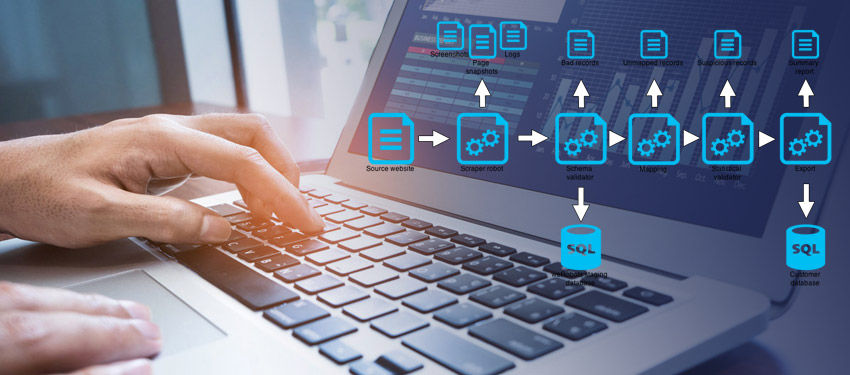
Data quality controls must operate at multiple points in the analytics pipeline — not just at data ingestion. Source system validation checks data quality at extraction, before data enters the analytical environment. Transformation validation verifies that data transformation logic produces expected outputs and does not introduce quality issues through incorrect business rule implementation. Load validation confirms that data loaded into target systems matches the expected record counts, checksums, and quality metrics. And reporting validation checks that analytical outputs are consistent with the underlying data and with related reports.
We design and implement this multi-stage validation architecture for financial analytics pipelines — providing defense-in-depth data quality assurance that catches different categories of quality issues at the stage where they are most efficiently detected and remediated, all traceable through robust Data Lineage Tracking.

Trusted Financial Data Through Master Data Management
Many data quality problems in financial institutions originate from the absence of robust master data management — the discipline of maintaining a single, authoritative record for each key entity in the business. When customer records exist in multiple forms across multiple systems, when the same counterparty is recorded under multiple names, and when product definitions are inconsistent between systems, data quality problems are structurally inevitable regardless of how carefully individual transactions are processed.
We design master data management frameworks for financial institutions that establish golden records for key entities — customers, counterparties, products, legal entities, and instruments — and maintain the matching and deduplication processes that keep these records current and consistent across the enterprise, delivering Trusted Financial Data your risk, finance, and analytics teams can rely on. Our Data Engineering & Integration services build the integration infrastructure that propagates master data updates to the downstream systems that consume them.
Financial Data Quality Framework Design
The Problem: Without defined standards, every team applies its own interpretation of what “good data” means.
What We Do: We develop enterprise-wide data quality frameworks that define clear standards, metrics, and accountability structures across your organization. Our Financial Data Quality Framework defines quality across five dimensions — accuracy, completeness, consistency, timeliness, and uniqueness — with measurable thresholds for each domain.
Output: Enterprise data quality standards documentation · Quality dimension definitions and measurement methodology · Domain-specific quality targets and thresholds · Roles and accountability matrix for data stewardship

Data Lineage Tracking and Regulatory Evidence
Demonstrating data quality is as important as achieving it — regulators conducting BCBS 239 assessments, auditors reviewing financial statement data processes, and internal governance functions monitoring data management effectiveness all require evidence that data quality standards are being met. We build data quality reporting frameworks that provide systematic, time-series evidence of data quality performance through full Data Lineage Tracking — measuring quality against defined standards, tracking trends over time, documenting the resolution of quality issues, and providing the data quality attestation capability that BCBS 239’s senior management sign-off requirements demand.
Automated Validation Rules & Pipeline Integration
The Problem: Manual data checks don’t scale. By the time a quality issue is discovered in a report or dashboard, it has often already propagated through multiple downstream systems making remediation far more expensive than prevention.
What We Do: We design and implement automated validation rules directly within your data pipelines catching errors at the earliest possible point in the data lifecycle. Validation logic covers data entry, system integration, transformation, and pre-reporting stages. Governance frameworks define standards for accuracy, completeness, consistency, and timeliness ensuring downstream processes rely on information that can be trusted. Our implementations embed those standards into the pipeline itself, not just the documentation.
Output:
- Automated validation rules deployed in data pipelines
- Pre-report data quality gates for regulatory submissions
- Integration with existing ETL, data warehouse, or cloud data platforms
- Validation logic documentation for audit purposes


Data Accuracy Monitoring: Real-Time Monitoring, Alerting & Issue Resolution
The Problem: Data quality isn’t a one-time fix. Data degrades, new sources introduce new issues, and system changes break validation assumptions. Without continuous monitoring, problems accumulate silently until they surface in a regulatory submission or an AI model output.
What We Do: We implement monitoring frameworks with real-time dashboards, automated anomaly detection, and alerting workflows that notify the right teams when quality thresholds are breached. Issue resolution workflows ensure problems are triaged, assigned, and resolved with full audit trails not just flagged and forgotten.
Output:
- Real-time data quality monitoring dashboards
- Automated anomaly detection and alerting
- Issue triage and resolution workflows
- Data quality KPI reporting for leadership and compliance teams
Regulatory Reporting Data Quality
The Problem: Regulatory initiatives like BCBS 239 highlight banks’ obligation to achieve timely, accurate, complete, and integrated risk data for both normal and stress conditions and failure exposes firms to supervisory findings, financial penalties, and slower crisis response.
What We Do: We build targeted data quality controls for your highest-stakes regulatory reporting domains capital adequacy, risk exposure, transaction monitoring, liquidity reporting, and financial performance. In 2023, only 2 of 31 global systemically important banks fully met all BCBS 239 principles we help you close the gap before your next examination.
Output:
- Regulatory reporting data quality controls by submission type
- Pre-submission validation checklists and automated checks
- Data lineage documentation for regulatory traceability
- Audit-ready quality evidence packages


AI-Ready Data Quality and Trusted Financial Data
The Problem: Machine learning models are only as reliable as the data they’re trained on. Gaps in important data points and incomplete transaction flows hinder the ability to effectively use AI-powered analytics for improving efficiency and profitability. Poor training data doesn’t just produce inaccurate predictions it introduces bias that can create regulatory and reputational exposure.
What We Do: We ensure your data quality frameworks extend into your AI and analytics pipelines validating training datasets, documenting data lineage for model inputs, and establishing quality gates that prevent low-quality data from reaching production models. The EU AI Act classifies financial AI as high-risk, mandating governed training data, bias documentation, and explainability audits our quality frameworks are designed to satisfy these requirements from the start.
Output:
- AI training data quality standards and validation
- Data lineage documentation for model inputs
- Bias and completeness checks for ML datasets
- Quality framework aligned to EU AI Act and SR 11-7 requirements
Financial Data Quality Framework — Data Stewardship & Continuous Improvement
The Problem: Technology alone doesn’t sustain data quality. Without clear human accountability and continuous improvement processes, validation rules become outdated, exceptions accumulate, and quality gradually erodes.
What We Do: We implement data stewardship programs that assign clear quality ownership within each data domain — with defined responsibilities, escalation paths, and regular quality audit cycles. We also establish feedback loops between analytics teams, compliance functions, and data owners so quality issues discovered downstream are systematically traced back and resolved at source.
Output:
- Data stewardship role design and training
- Domain-level quality audit schedule and process
- Continuous improvement governance structure
- Quality trend reporting and improvement tracking

Many data quality challenges arise from fragmented systems and inconsistent processes across business units. Financial organizations often operate with multiple legacy platforms, external data providers, and operational systems that were not originally designed to share data seamlessly. As information moves across these environments, inconsistencies and errors can occur.Common data quality issues include duplicate records, missing values, inconsistent data formats, and outdated information. These problems may originate during data entry, integration, transformation, or reporting stages. Without clear validation controls, such issues can propagate throughout systems and affect multiple departments.
Identifying the root causes of these issues is an essential step in building a sustainable data quality framework. By analyzing how data is created, processed, and used across the enterprise, organizations can pinpoint where quality problems occur and implement targeted solutions. A proactive approach to data quality not only corrects existing issues but also prevents new problems from emerging. This enables organizations to create a reliable data environment that supports both operational efficiency and strategic decision-making.