
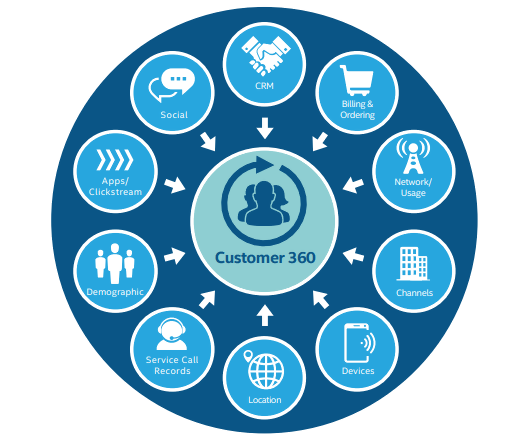
Customers interact with financial institutions through multiple channels. They may use mobile banking applications, websites, branches, ATMs, payment platforms, loan services, investment products, and customer support channels. Each interaction can generate valuable information, but when these datasets remain disconnected, organizations may only see individual pieces of the customer relationship.
Customer 360 Analytics addresses this challenge by bringing customer information together across different systems and touchpoints. Instead of analyzing a transaction, service request, or product interaction in isolation, financial organizations can develop a broader understanding of customer behavior, preferences, financial activity, and engagement.
This unified perspective gives banks and fintech companies the foundation they need to make faster and more informed decisions.
Customer 360 Analytics for a Unified Financial Customer Profile
A successful Customer 360 strategy connects data from multiple sources and creates a consistent customer profile. Transaction histories, product ownership, digital engagement, customer service interactions, demographic information, behavioral patterns, and other relevant data can be brought together within an analytics environment.
The value goes beyond simply storing information in one location. Advanced analytics and machine learning can identify relationships and patterns that may not be obvious through conventional reporting.
For example, a bank may identify that a customer frequently uses international payment services, has recently increased account activity, and has begun exploring investment-related content. Instead of treating these activities separately, an analytics platform can identify a potential opportunity for a relevant financial product or service.
This is where Data Geny’s finance-focused analytics expertise becomes particularly valuable. Its approach combines data engineering, predictive modeling, customer analytics, and visualization to help financial organizations turn complex datasets into practical intelligence.
Customer Analytics Solutions That Turn Behavior Into Business Intelligence
Customer Analytics Solutions help financial organizations understand not only who their customers are but also what they are likely to do next.
Traditional reporting often answers questions such as:
- How many customers purchased a particular product?
- Which customers stopped using a service?
- What was last quarter’s revenue?
- Which segment generated the most activity?
Modern analytics can go further by asking predictive questions.
Which customers are most likely to churn? Which customers could be interested in another financial product? What behavioral signals indicate changing financial needs? Which customer segments have the highest long-term value?
Data Geny develops analytics capabilities that can support these types of use cases. Its services include customer lifetime value modeling, churn prediction and retention analytics, customer segmentation and personalization, customer profitability analysis, and behavioral analytics.
By applying machine learning and predictive techniques to customer data, financial institutions can move from broad assumptions to more precise, evidence-based strategies.
Customer Journey Analytics Reveals What Happens Across Every Touchpoint
Understanding individual customer behavior is important, but understanding the complete customer journey can reveal even greater opportunities.
Customer Journey Analytics examines interactions across multiple stages of the customer lifecycle. For a financial institution, that journey might begin with online research, continue through an application, move into onboarding, and eventually develop into long-term product usage and support.
Analyzing this journey can help organizations identify friction points and understand where customers disengage.
For example, if many prospective customers begin a loan application but abandon it before completion, journey analytics can help identify potential reasons. Perhaps the process requires too many steps, the documentation requirements are unclear, or customers encounter difficulties on a particular digital channel.
Once these patterns become visible, organizations can prioritize improvements based on actual customer behavior rather than assumptions.
AI and Machine Learning Make Customer Intelligence More Predictive
The latest generation of customer analytics is increasingly powered by artificial intelligence and machine learning.
Rather than relying solely on historical reports, financial organizations can use predictive models to identify likely future behavior. Machine learning can support churn prediction, customer segmentation, propensity modeling, cross-sell and upsell analytics, and customer lifetime value forecasting.
Data Geny’s broader Machine Learning & AI Solutions support applications such as AI-driven decision intelligence, explainable AI for financial models, natural language processing analytics, and intelligent process automation.
This combination of customer intelligence and AI allows financial institutions to develop more responsive strategies while maintaining the governance and transparency required in financial environments.
Real-Time Customer Intelligence Is Becoming a Competitive Advantage
Customer expectations are increasingly shaped by digital experiences. Customers want relevant services, quick responses, and seamless interactions across channels.
This makes real-time analytics increasingly important.
Instead of waiting for a monthly or quarterly report, financial organizations can process customer signals as they occur. Real-time data processing can help identify changes in transaction behavior, engagement patterns, or customer activity.
For example, a sudden change in account behavior could trigger an appropriate review, while increased engagement with a particular financial product could indicate an opportunity for personalized communication.
Data Geny’s Data Engineering & Integration capabilities, including real-time data processing and analytics-ready data engineering, help establish the data foundation required for these applications.
Connecting Customer Intelligence With Revenue Growth
Customer analytics should ultimately connect to measurable business outcomes.
A comprehensive customer view can help financial institutions identify cross-sell and upsell opportunities, improve retention, increase customer profitability, and develop more relevant products.
Customer segmentation can also help organizations move away from generic campaigns. Different customer groups can receive communication and offers based on their behaviors, needs, and predicted interests.
Customer 360 Analytics therefore becomes more than a data initiative. It can become a strategic capability connecting customer understanding with revenue analytics and business performance.
Data Governance Must Support Customer Analytics
Financial customer data is highly sensitive, making governance an essential component of any customer analytics strategy.
Organizations need appropriate controls around data quality, privacy, access, lineage, security, and model governance. Analytics systems must also provide reliable information that teams can trust.
Data Geny’s services include Enterprise Data Governance & Privacy Strategy, Data Quality Management & Validation, Model Risk Management, Model Governance & Monitoring, and Cloud Data Security, Governance & Compliance.
Embedding governance into the analytics lifecycle helps organizations build customer intelligence responsibly while supporting regulatory and operational requirements.
How Data Geny Helps Financial Organizations Build Customer Intelligence
Data Geny is specifically focused on analytics for banks, fintech companies, lenders, and financial institutions. Rather than applying generic analytics frameworks to financial use cases, its services are designed around the industry’s data, risk, compliance, and decision-making requirements.
Its capabilities span Customer Analytics Solutions, predictive analytics, customer segmentation, customer profitability analysis, data engineering, machine learning, business intelligence, real-time processing, and enterprise data governance.
This combination allows organizations to build a connected analytics environment where customer data can move from raw information to meaningful intelligence and ultimately into business decisions.
Creating a More Intelligent Customer Strategy
Customer expectations, digital interactions, and financial data are continually evolving. Organizations that can connect these signals effectively will have a stronger foundation for personalization, retention, risk management, and growth.
Customer 360 Analytics provides the complete perspective. Customer Analytics Solutions turn that perspective into measurable insights, while Customer Journey Analytics reveals how customers interact with an organization across every stage of their relationship.
With advanced machine learning, real-time processing, modern data engineering, and strong governance, financial institutions can build customer intelligence systems that are not only informative but predictive and actionable.
Data Geny helps bring these capabilities together, enabling financial organizations to move beyond fragmented customer data and develop a more intelligent, connected approach to customer decision-making.